Blog and news
Through the eyes of a Bermudian: Chathams conservation (Part One)
Miguel Mejías, a conservationist from Bermuda, shares his experience travelling to the Chatham Islands to get insights into island conservation from one part of the world, to carry back to another. Part One covers the first leg of his trip, geared around black robins, tāiko, and learning how predator elimination is done in the Chathams.
From Bermuda to Chatham Island
As a kid, I wanted to be a Marine Biologist. That was the “go to” response of most children who grew up in Bermuda, my home country. Later, at 21, I was introduced to the realm of Ornithology and Conservation by my neighbour, world-renowned avian conservationist Dr. David Wingate. I went to Memorial University of Newfoundland to complete graduate work on the ecology and conservation of Bermuda’s avifauna – or, in other words, our islands’ amazing birds.
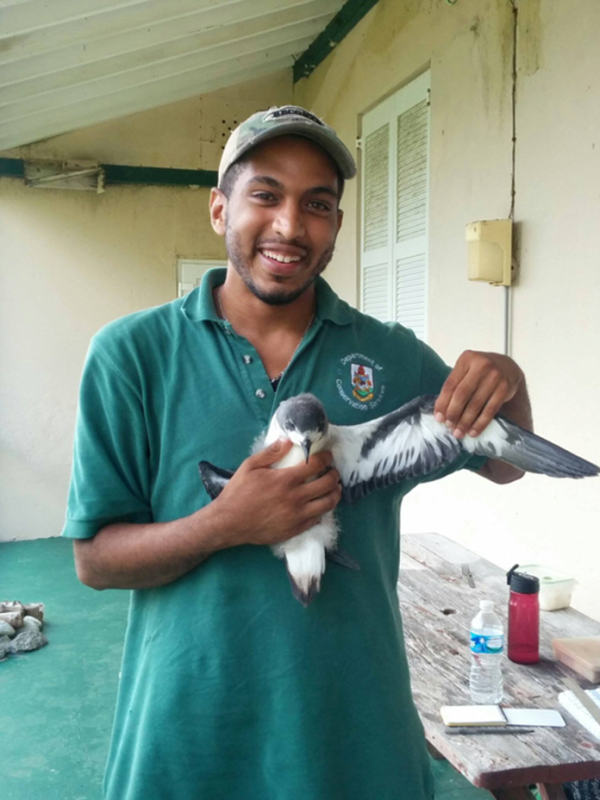
Miguel Mejías holding a Bermuda petrel or cahow, Bermuda’s National Bird, on Nonsuch Island, Bermuda, 2016.
Bermuda is 8,700 miles (14,000km) from the Chatham Islands. Both archipelagos are remote oceanic islands whose indigenous flora and fauna were negatively impacted by human settlement.
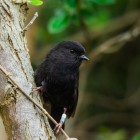
When a chance arose to join a two-month trip banding the fabled Chatham Islands black robin/ karure/ kakaruia (Petroica traversi) in March 2026, I was keen to take it. As well as being a rare opportunity, I knew I could learn and later adopt some of the Chathams’ novel predator control techniques back on my home island.
My name is Miguel Mejías, and I’m a Bermudian Ornithologist, Conservationist, and Naturalist. This is my story of my epic journey and experience in the Chatham Islands.
When I arrived on Rēkohu/ Wharekauri in the Chatham Islands on 5 March 2026, I was immediately taken aback by its vastness. Coming from a country whose widest areas are barely a mile wide, I was not used to land and beaches that stretched as far as the eye could see. Bermuda is about 21 square miles (33.7 km) in size and has 64,000 inhabitants, whereas the biggest island in the Chathams is 571 miles (920 square km) with a population of around 600.
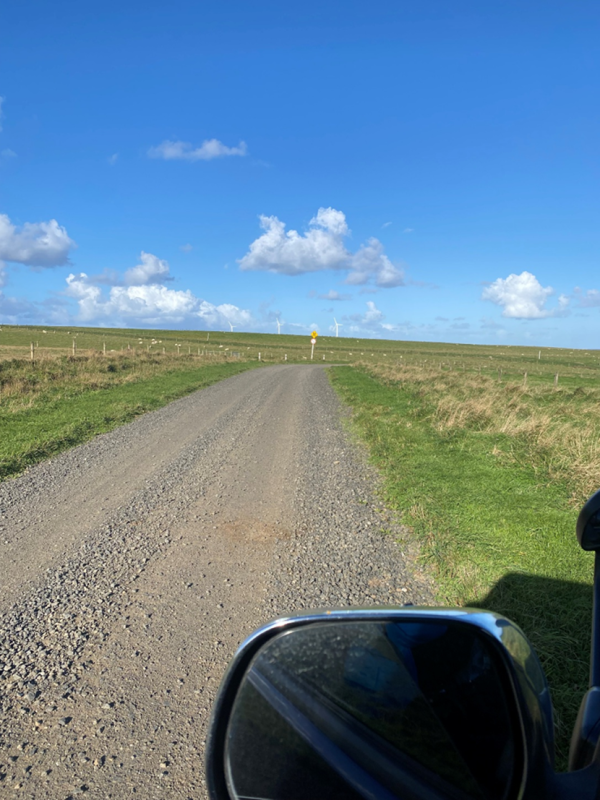
Typical dirt and gravel roads of the Chatham Islands. I found the continuous “ping-ping-ping” sounds of the pebbles smacking the underside of the vehicles I rode in quite soothing.
Albatrosses and a change in plans
My trip began with a birding tour run by Steve Wood and Bradley Shields. My personal favourite moment of our boat trip was seeing Chatham albatrosses (Thalassarche eremita) just off their iconic and only breeding ground, The Pyramid. This was my most sought-after bird species, and, I think, my current new favourite bird.
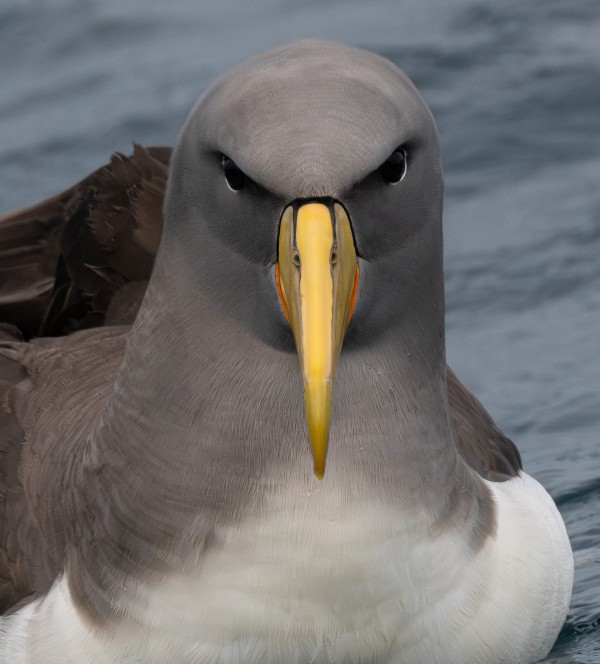
The endemic Chatham Albatross (Thalassarche eremita) seen afloat off its only breeding site, The Pyramid. Image: Miguel Mejías
After the tour ended, I had a week before my black robin expedition. Jenna Hoverd from the Chatham Island Taiko Trust organised a stay for me at the infamous Tāiko Camp, home to literally the rarest seabird on Earth, the magenta petrel/ tāiko (Pterodroma magenta)! The Chatham Island tāiko shares a similar story to the Bermuda petrel or cahow (Pterodroma cahow): a significant decline post-human settlement, followed by an increase in population due to conservation programmes. Given my dream of managing cahows, I couldn’t think of a better place to visit!
The scale of the forest here made Bermuda woodlands feel like oversized hedgerows, and the 14km trek through the Tuku Nature Reserve to get to Camp was the equivalent of walking 35% of the entire length of Bermuda! Throughout the forest were invasive predator traps targeting rats and Brushtail possums. Dave Boyle, the primary caregiver of tāiko, took me to the predator-fenced forest that protects tāiko and other nesting seabirds. I had a chance to see tāiko and Chatham Island petrels/ ranguru (Pterodroma axillaris) flying in under a starry night sky. Words fail to describe my excitement, especially when I had the opportunity to band a ranguru.
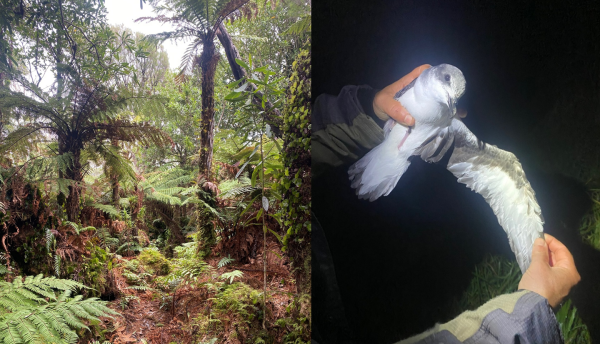
Forest stand within the Tuku Nature. Dave Boye holds a ranguru. Images: Miguel Mejías.
I returned to the DOC office to begin prepping for our month-long black robin expedition, starting with two days of quarantining my belongings for the trip to the pest-free nature reserve island, Mangere/ Maung’Re.
Unfortunately, plans for this trip suddenly changed, and I found myself no longer able to take part.
I spent some time mulling over what to do, and sought advice from my friends across the globe. Some were adamant that things happen for a reason, and that something better was around the corner. They would be proven right a few days later.
Predator control in action for the environment
Typical of island life, something a Bermudian like me knows all too well, word of my predicament spread across Chatham like wildfire.
Mike Bell, a seasoned ornithologist and conservationist, learned of my situation and reached out to discuss ways I could volunteer in the field. He’s also a Trustee of the Chatham Islands Landscape Restoration Trust, a small group whose goal is to restore and preserve indigenous flora and fauna of the Chathams. One of their ongoing projects is to see a “predator free Chathams,” where introduced pests, including rats and possums, are removed from the islands by 2050.
I quickly realised I’d be able to put what I learned from Mike and his colleagues into practice back in Bermuda, and eagerly accepted Mike’s offer to help service and expand their trap network.
Mike and Hamish Chisholm, the Project Lead for the Trust, picked me up for my first day in the field. The three of us drove just over an hour to Kaingaroa, a small fishing village on the northeastern tip of Chatham Island. We filled a trailer with their preferred traps: automatic, self-resetting AT220s for targeting rats and possums.
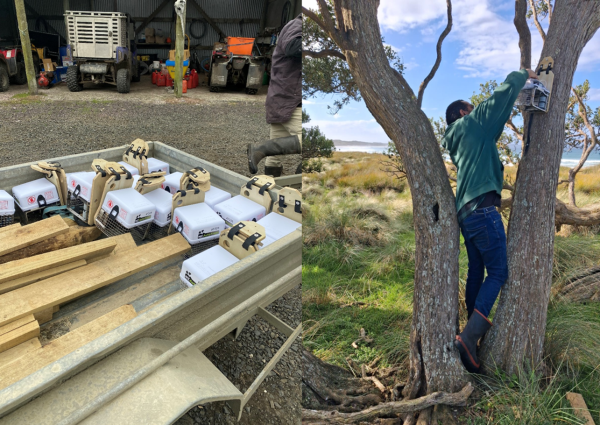
A trailer filled with New Zealand AT220 traps (left) and the author mounting them on a tree for rat and possum control. Images: Miguel Mejías and Mike Bell.
Before deploying the new traps, Mike and Hamish took me to a nearby home where the owner had a couple of AT200s mounted on trees within their backyard about 1 metre off the ground. Hamish and Mike gave me a thorough breakdown of the trap’s capabilities.
The high-impact strike of the “kill bar” is so fast, the human eye cannot see it! Each trap has a built in WiFi network, allowing users to connect to it through a phone app and check the number of trap triggers (which are treated as individual pest kills), the trap’s battery life, how clean its sensors are, and the ability to manually trigger the trap. Directly beneath the trap was a wood plank bolted at a 45° angle, acting as a “rat ladder.” The trap was connected to a small plastic pouch carrying a non-toxic lure, which the trap can automatically extract and dispense into a tiny metal tray, attracting rats and possums up the ladder, towards the trap bar.
After the tutorial, I teamed up with Mike to deploy 10 new traps and service roughly 20 previously set traps in the surrounding bush and paddocks of Kaingaroa. Due to the rugged terrain and large distances between traps, we got around using ATVs.
Our initial workflow as a team involved Mike mounting the trap and rat ladder, while I removed the trap lid, then installed the lure pouch and battery, before turning on the trap’s WiFi, which allowed Mike to use his phone to dispense lure and arm the trap.
When it came to servicing traps already in the field, I was responsible for changing the battery and replacing the lure pouch, both of which were usually empty. This was a clear sign of an active trap tirelessly eliminating rats and possums. The batteries allowed AT220s to automatically eliminate pests over a 3-month period. To my amazement, virtually every trap we serviced had successfully removed at least one rat and/or possum.
I would accompany Mike, Hamish, and eventually Samantha Ray of Wildlife Management International Limited, for several more trap setting and servicing days in the field. Eventually, I was experienced and confident enough to secure the traps to trees and arm them using the phone app.
By the end, I had helped service 164 traps and install 38 new traps. The very last trap I installed ended up being the 200th trap in the network, an amazing accomplishment for the Chatham Islands Landscape Restoration Trust!
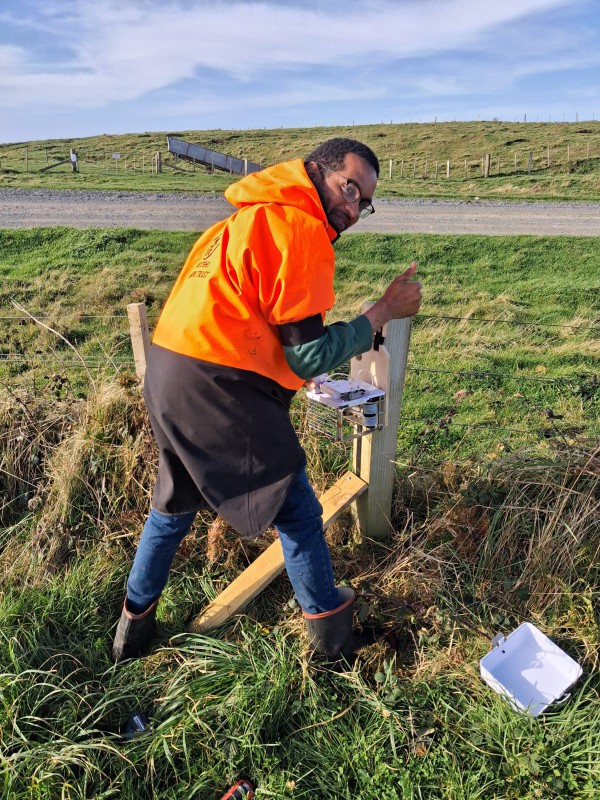
Miguel putting out Trap #200.
Keep an eye out for Part Two, where Miguel finally gets to see black robins as part of a seabird translocation trip.