Blog and news
Species Spotlight: Lichens
Lichens: mysterious communities that live in the most variable of places, from barren to fertile, and are absolutely everywhere in the Chatham Islands. Lichens are an underappreciated and overlooked part of our world, yet they contribute more to our ecosystems than we realise. Scientist Campbell James shares his appreciation for these symbiotic species in the Chatham Islands.
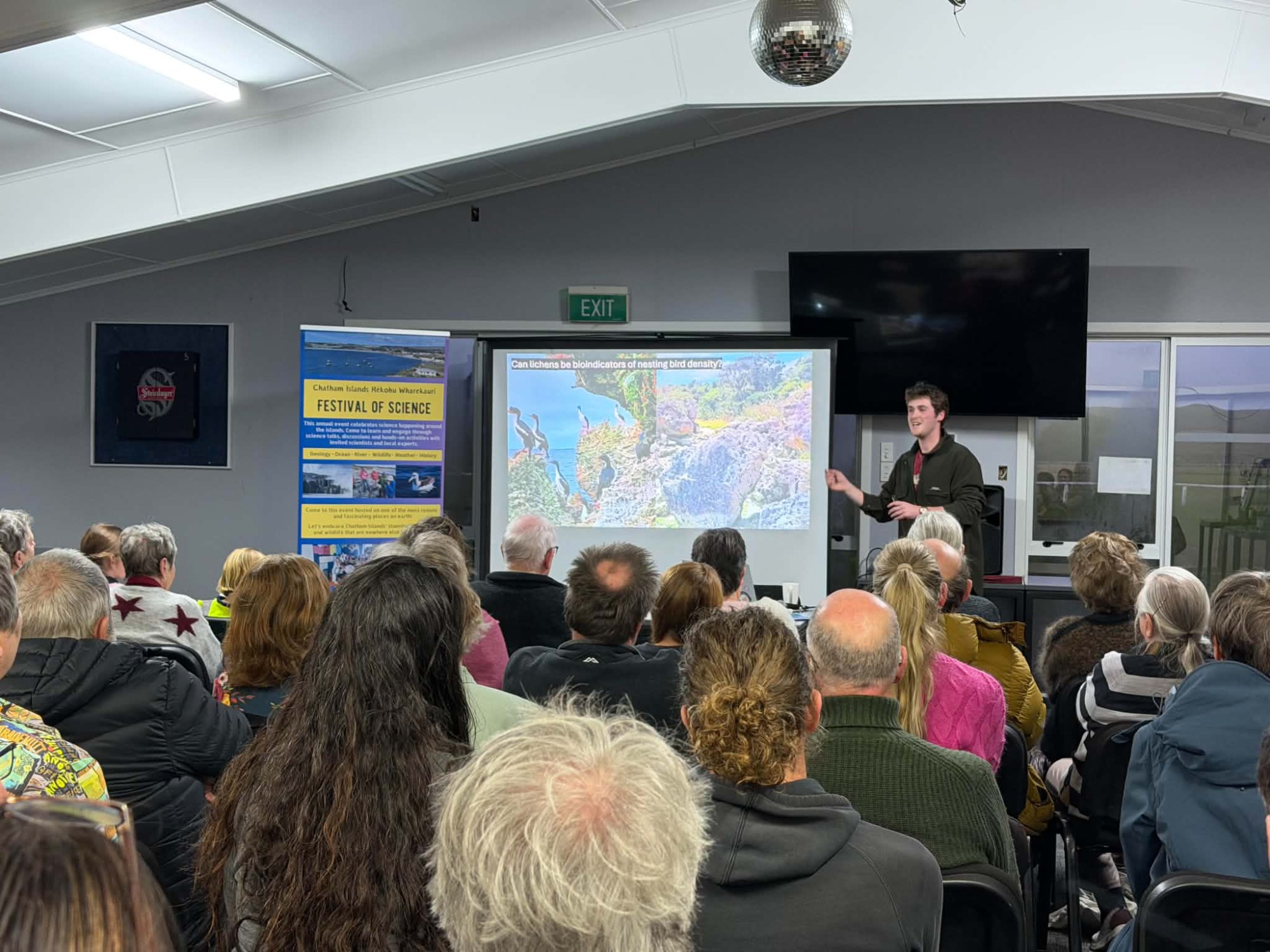
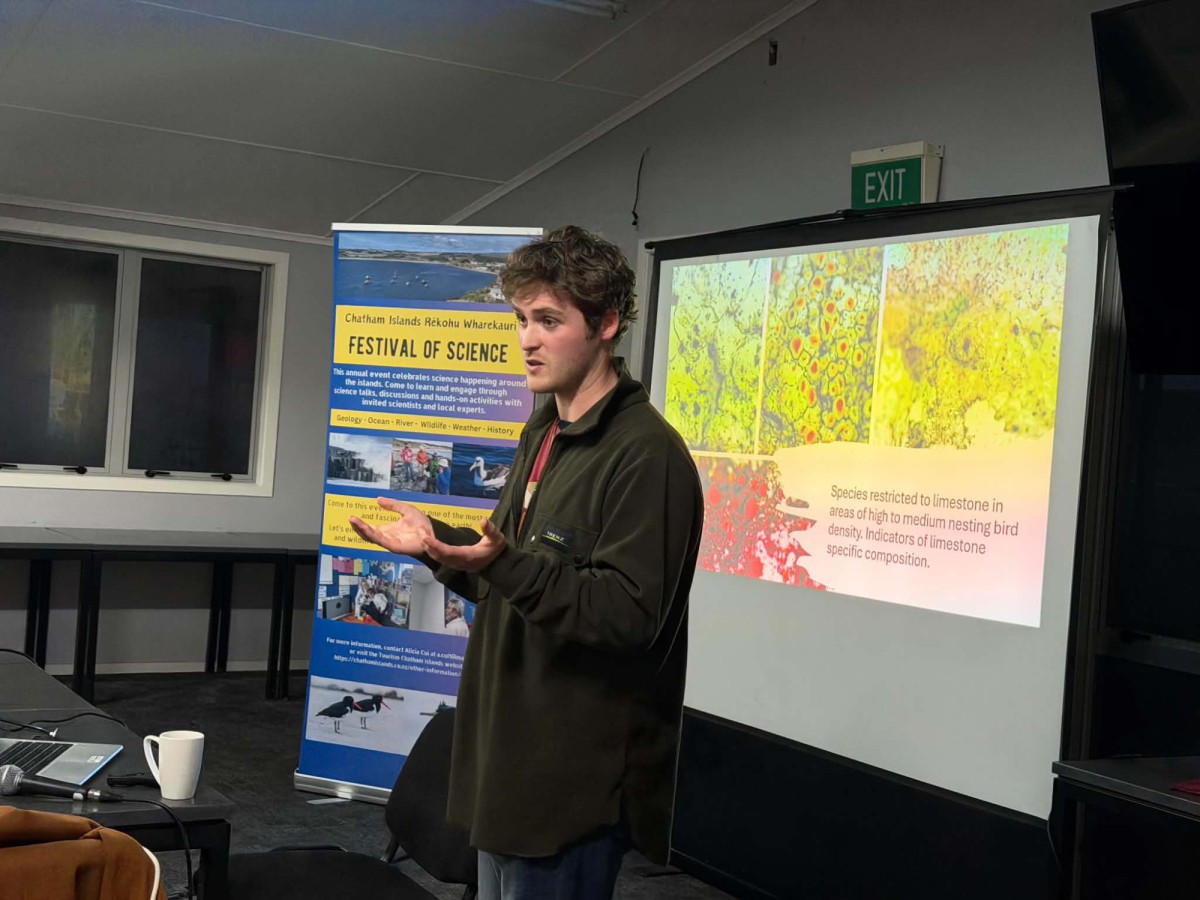
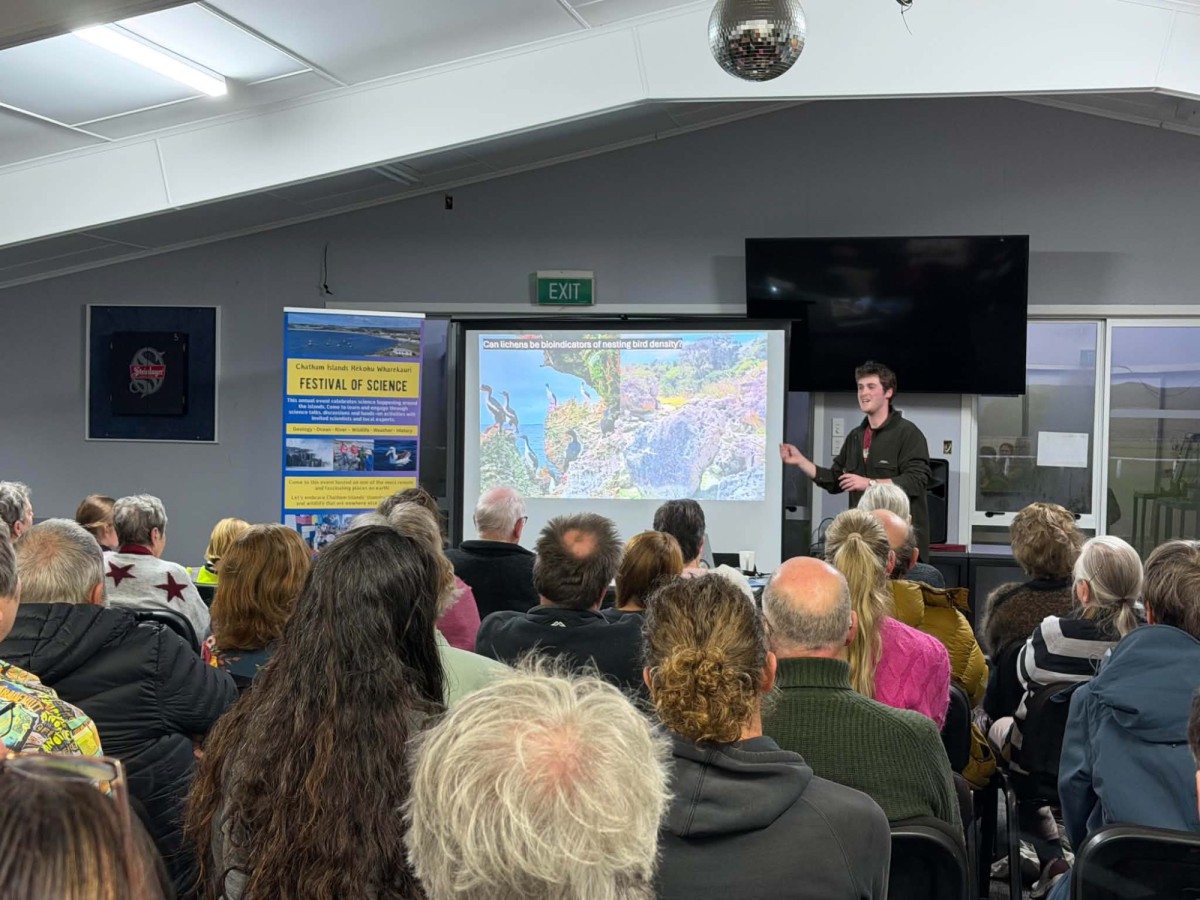
Can lichens be bioindicators of nesting bird density? Campbell James introducing one of his areas of research at the Festival of Science 2026.
One lichen is at least two organisms.
Lichens are not just ‘one thing,’ despite what they might look like. They are a community: a group of organisms living in a mutually beneficial relationship known as symbiosis.
Collectively, lichens can be called “symbionts.” They’re made up of fungi, and algae or cyanobacteria (or, sometimes, both). Fungi (known as the “mycobiont”) create the exterior structure of the lichen.
This structure forms a ‘house’ for algae and cyanobacteria. These organisms go through photosynthesis (and are also known as “photobionts”) and it’s this process that creates food for a lichen. The food produced by photosynthesis is used by the organisms themselves and is also ‘farmed’ and consumed by the fungi.
Fungi make the home; algae make the dinner.
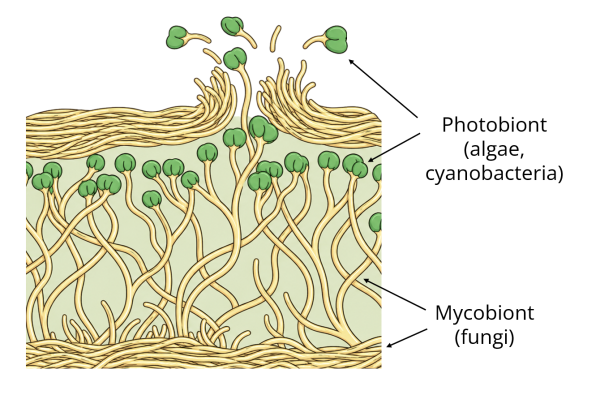
The basic structure of a lichen.
Lichen grows nearly anywhere, playing an important role in nature.
Lichens are diverse. They can grow on nearly any surface: rocks, trees, leaves, wood, cars, plastic, glass, tires.
They tend to thrive in environments where many plants struggle. Lichens are often the first life forms to colonise rock surfaces and areas stripped of soil. They help break down rock minerals as a first step to building soil. They can also reduce erosion and help fix nitrogen.
The distribution of lichens can reveal a lot about an environment. Areas of high diversity and rare species indicate a healthy habitat. However, there is a still a lot to learn about lichens.
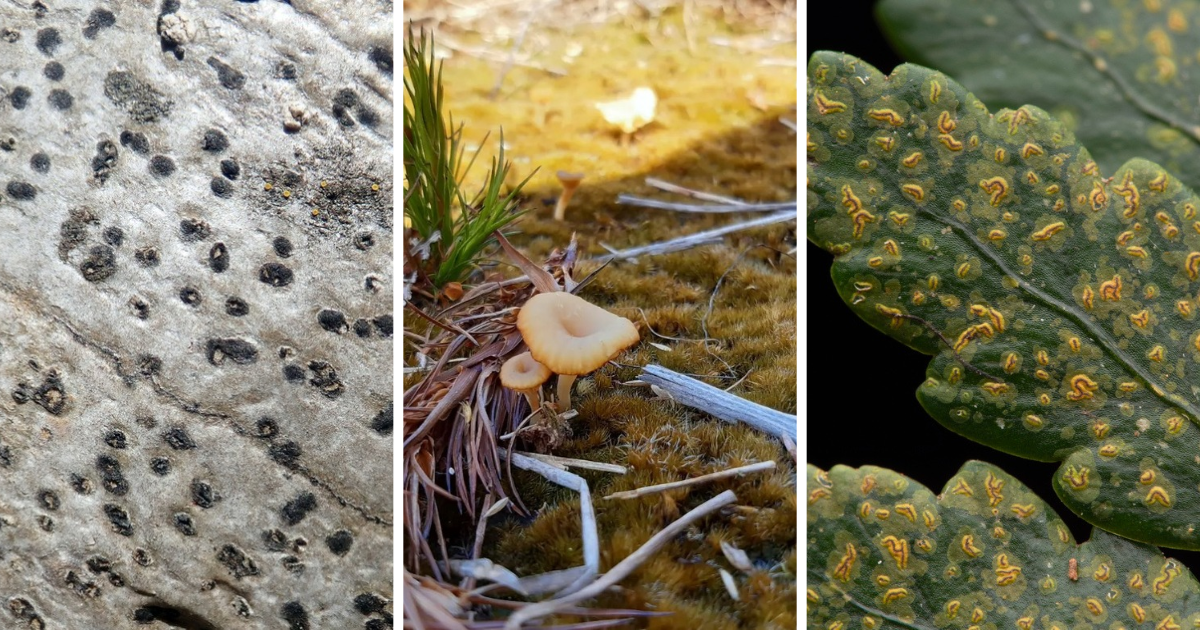
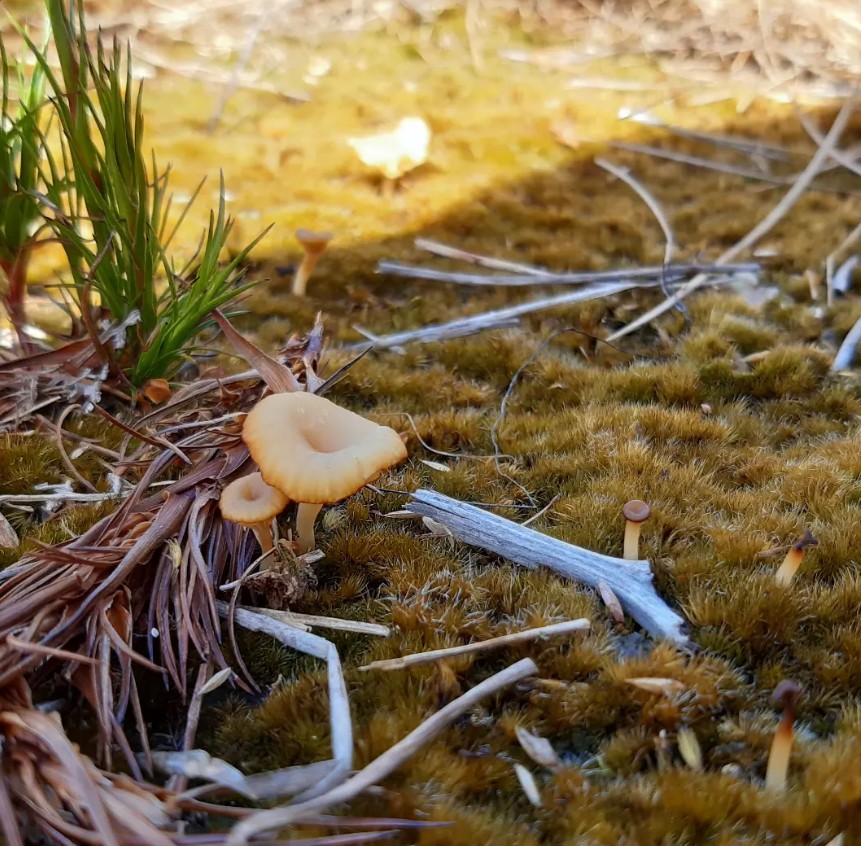
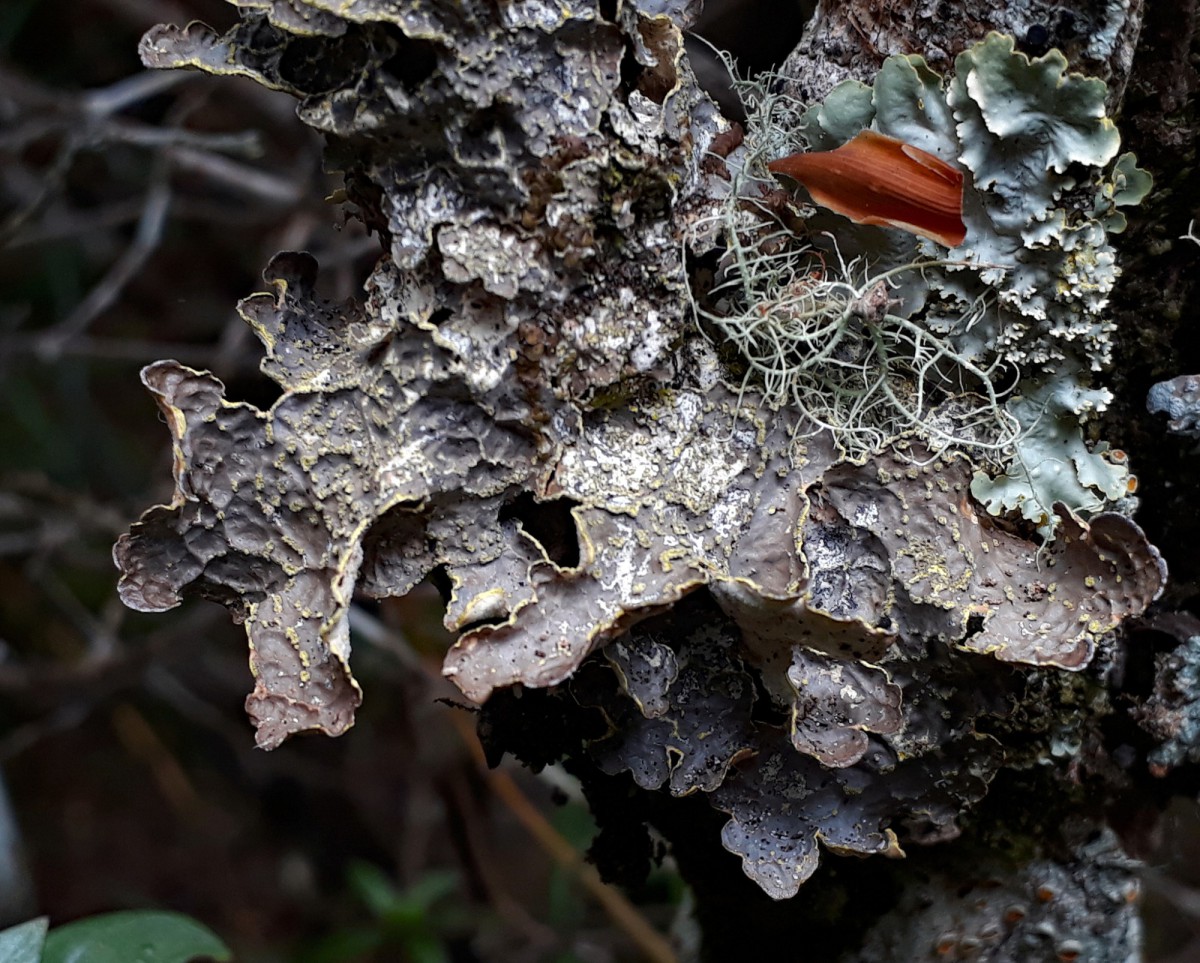
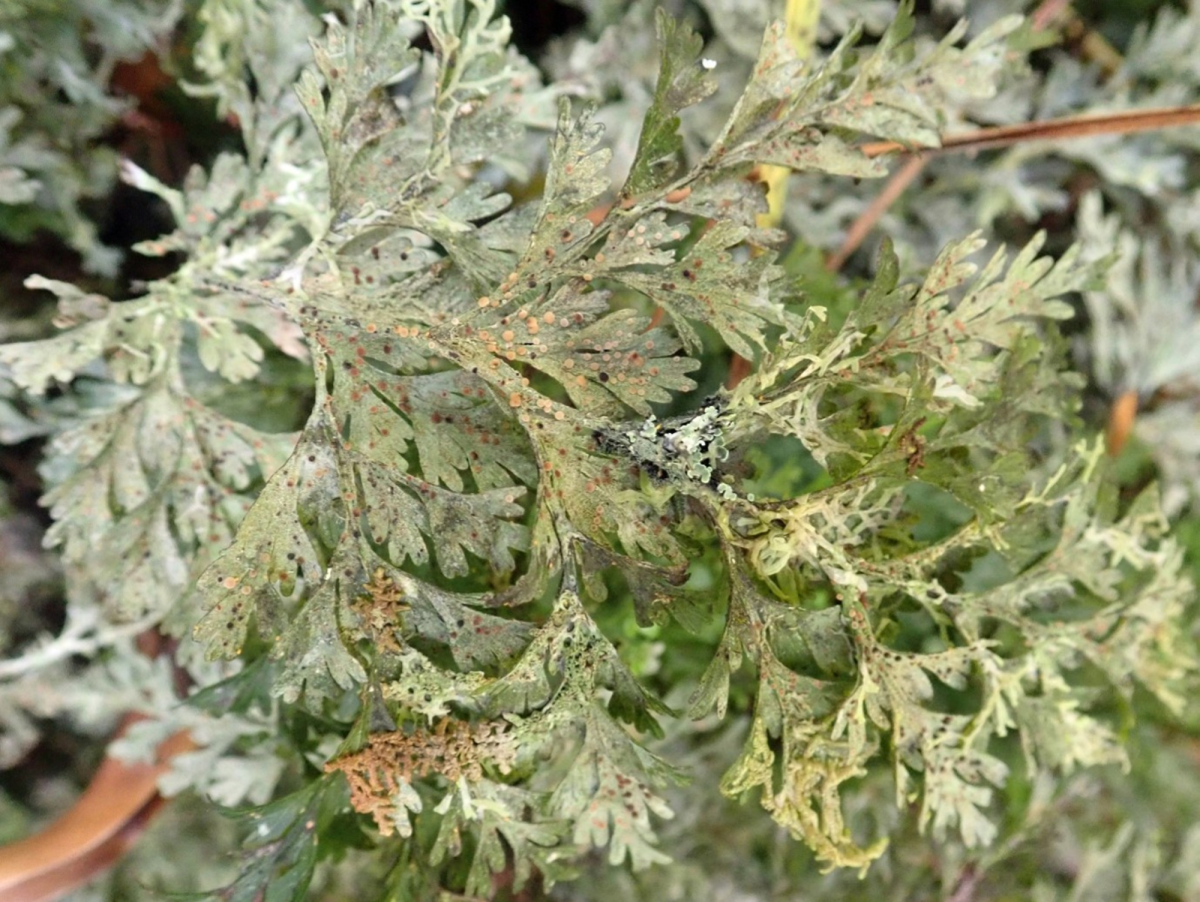
These are all lichens. From left, Pyrenula quadratolocularis, an undescribed Lichenomphalia species, and Enterographa bella.
Around 20% of Aotearoa’s lichens are found in the Chathams.
Rēkohu Wharekauri holds an impressive percentage of lichen species. Around 400 of the 2,000 species known in Aotearoa are recorded from the island, all in varying structures and appearance. Some are unique to the Chathams.
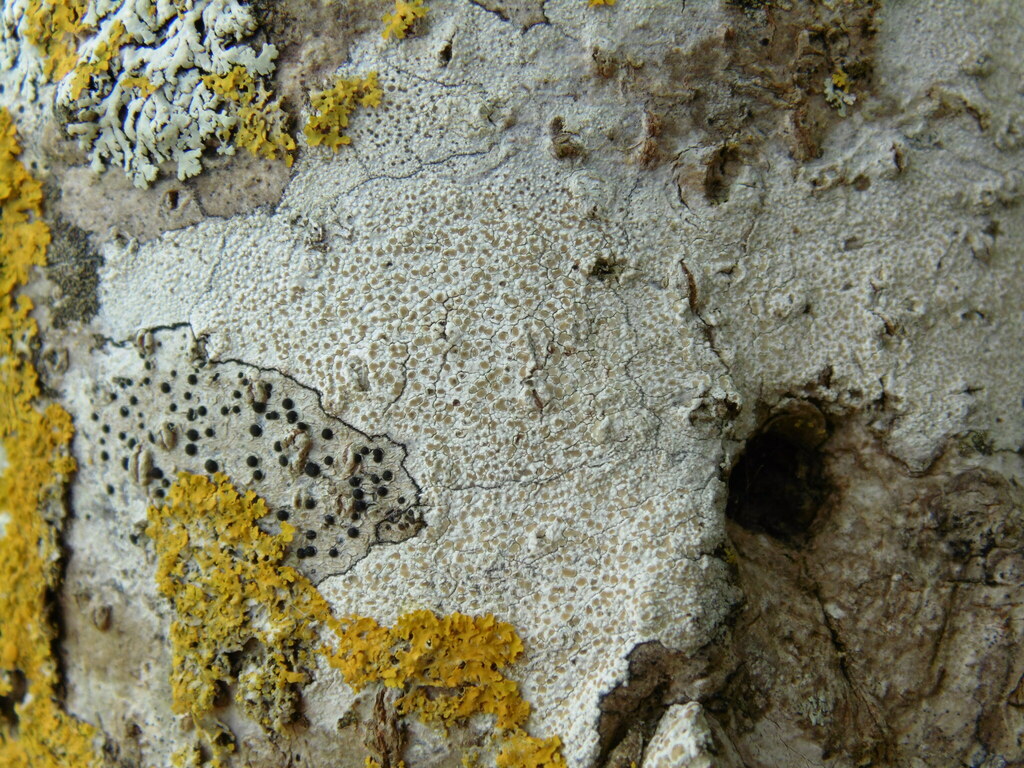
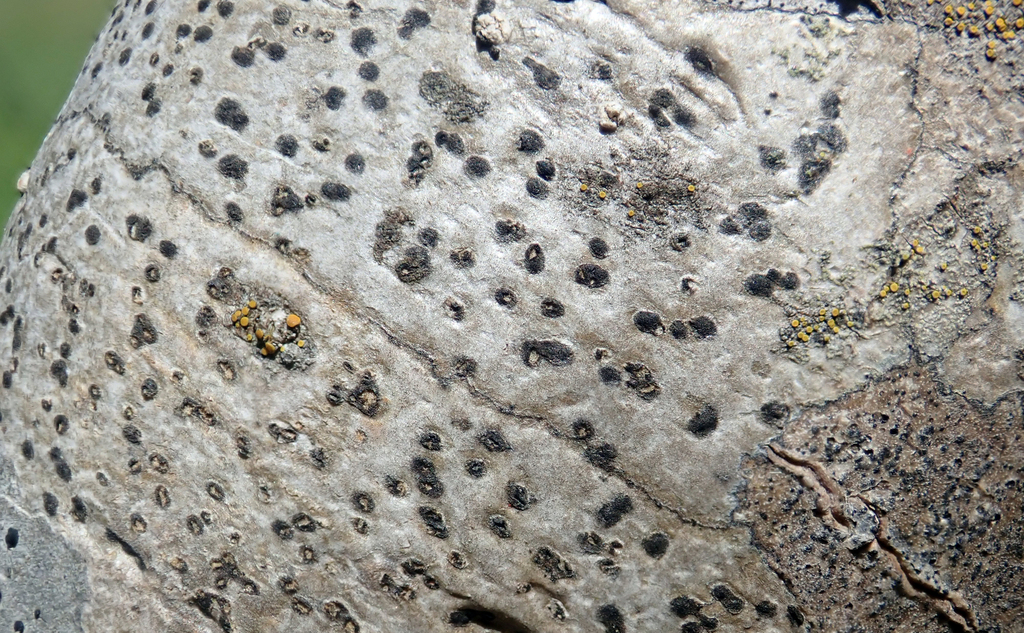
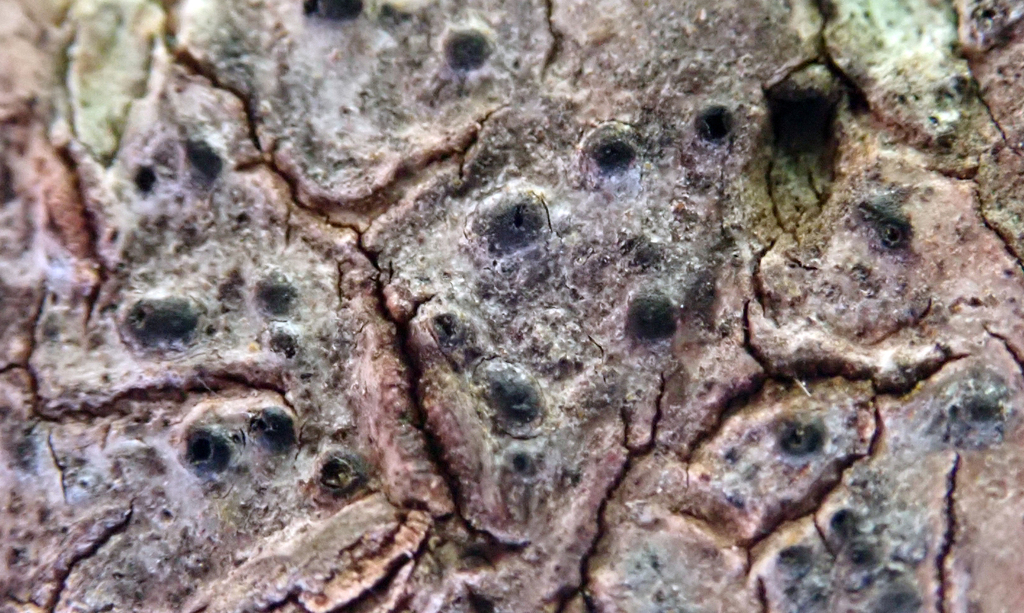
Work over the past decade from Dr Peter de Lange, Dr Dan Blanchon, and Andrew Marshall, has described species found only here. This includes the somewhat inconspicuous rash lichens, Pyrenula quadratolocularis and Pyrenula solomonii.
While they may appear unimpressive to most, they reveal that the island holds a diversity that is slowly being uncovered.
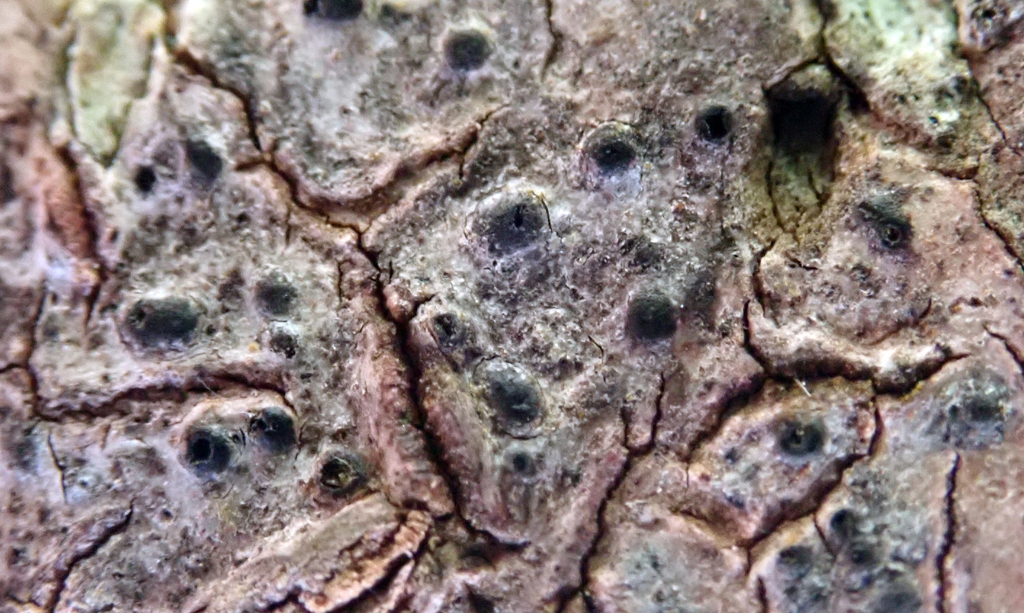
Endemic Pyrenula solomonii growing on hikoa karamu at Nikau Bush. Image: Peter de Lange.
One species had to travel the world to be named by science.
Lecanora kohu, another endemic (yet common) species, baffled scientists when it came to being formally described. There was uncertainty about which genus the new lichen should be placed in under the scientific Taxonomic Hierarchy, which is the official classification system that gives us a shared language to identify species and show how they relate to each other.
A sample was sent as far as the United States and then on to Germany, where they examined the lichen’s molecules in a lab. Only then were was it able to be placed in the genus of Leconara, at last being scientifically recorded and receiving its formal name from local lichenologists.
The “kohu” in the name refers, of course, to mist, as is the island’s Moriori name “Rēkohu.”
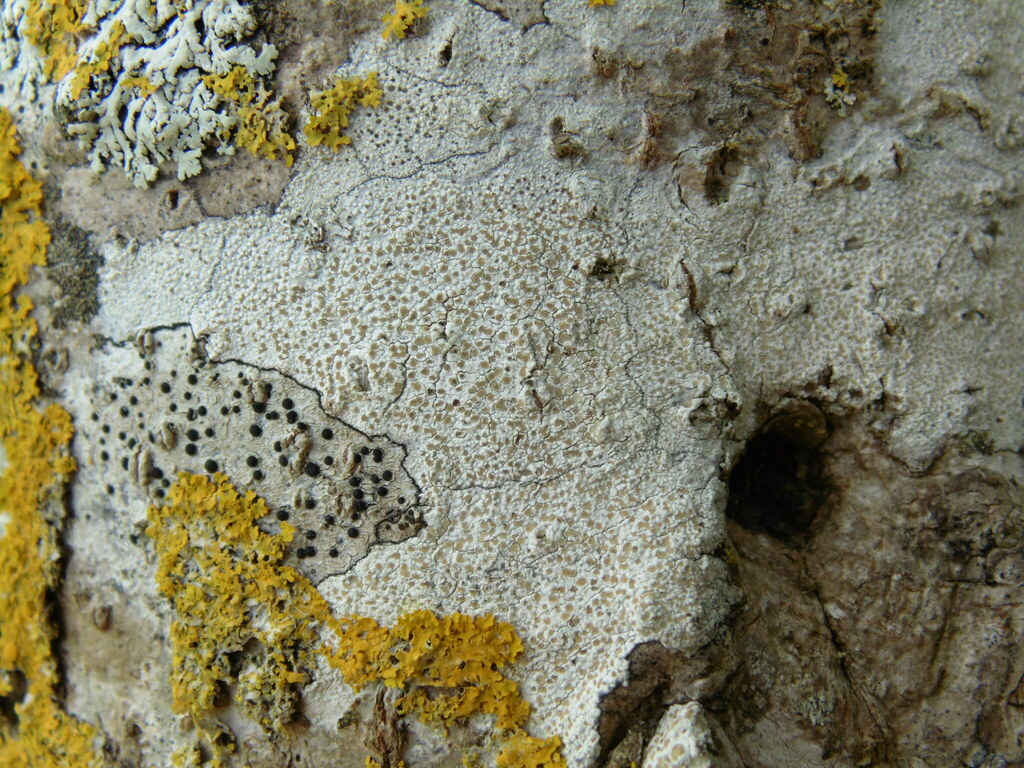
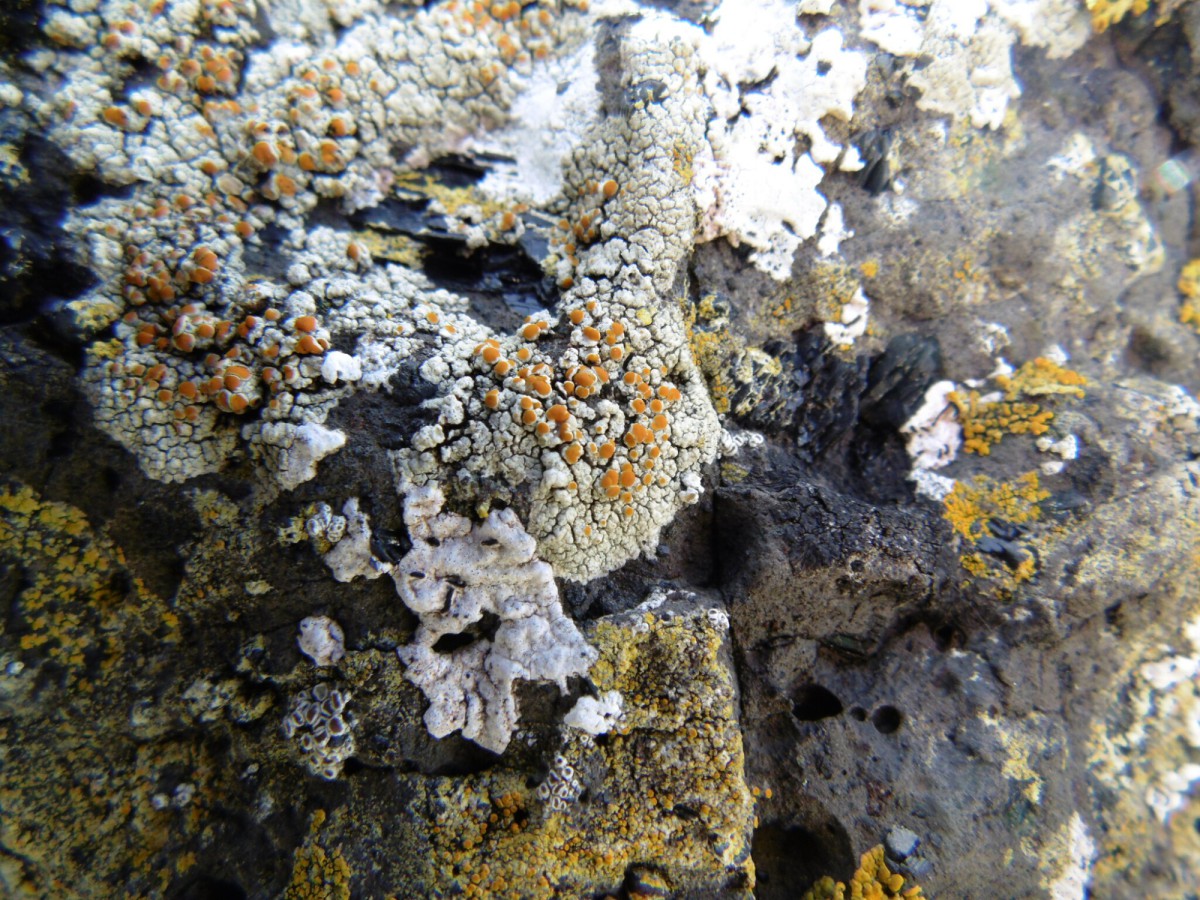
The common but world-travelling endemic species Lecanora kohu (centre) growing on inihina at Port Hutt. Image: Campbell James.
Rēkohu Wharekauri provides the perfect combo of climate and unique habitats.
The climate of Rēkohu is particularly supportive of lichens, which is perhaps what fosters the islands’ diversity. Lichens cannot store their own water, so the cool, humid, foggy environment is welcoming.
The island’s unique habitats undoubtedly contribute to the unique assemblage of lichen species.
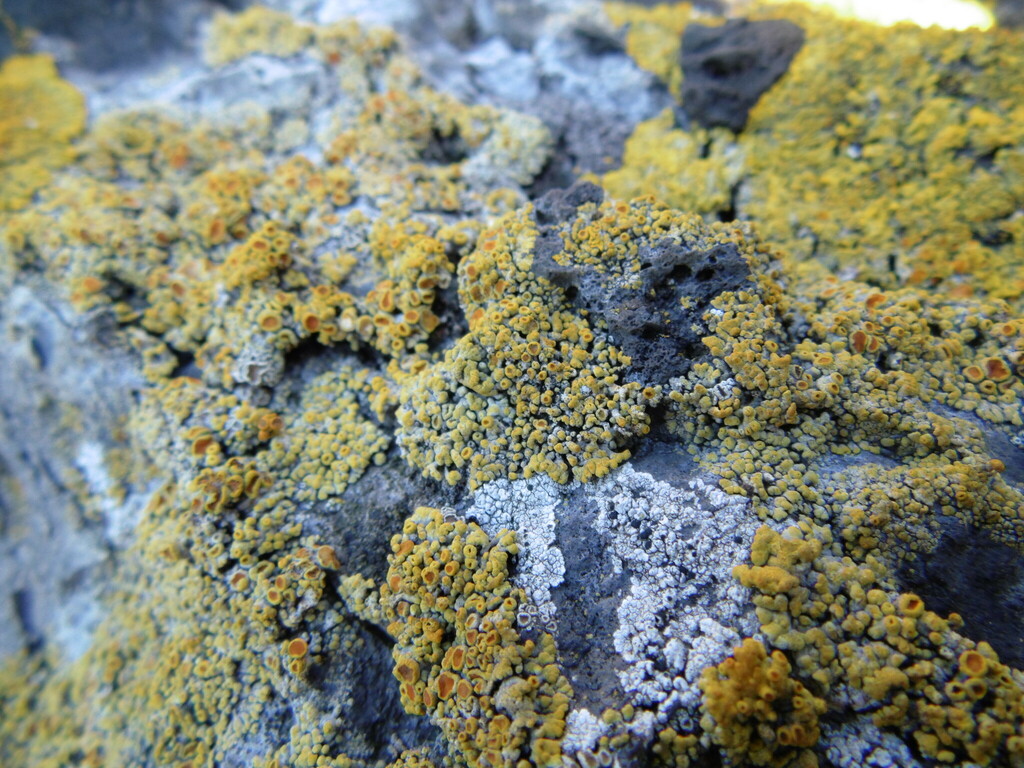
Coastal basalt is prime for many colourful lichens such as Gondwania cribosa, and Sirenophila macquariensis which is found in the Chathams, the subantarctic islands, and Otago. Along tracks in iconic peat bogs, Lichenomphalia look like typical mushrooms, but are actually lichens (pictured above). Near the base of their stalk, small algal colonies can be found associating with the fungi. This species has yet to be officially named.
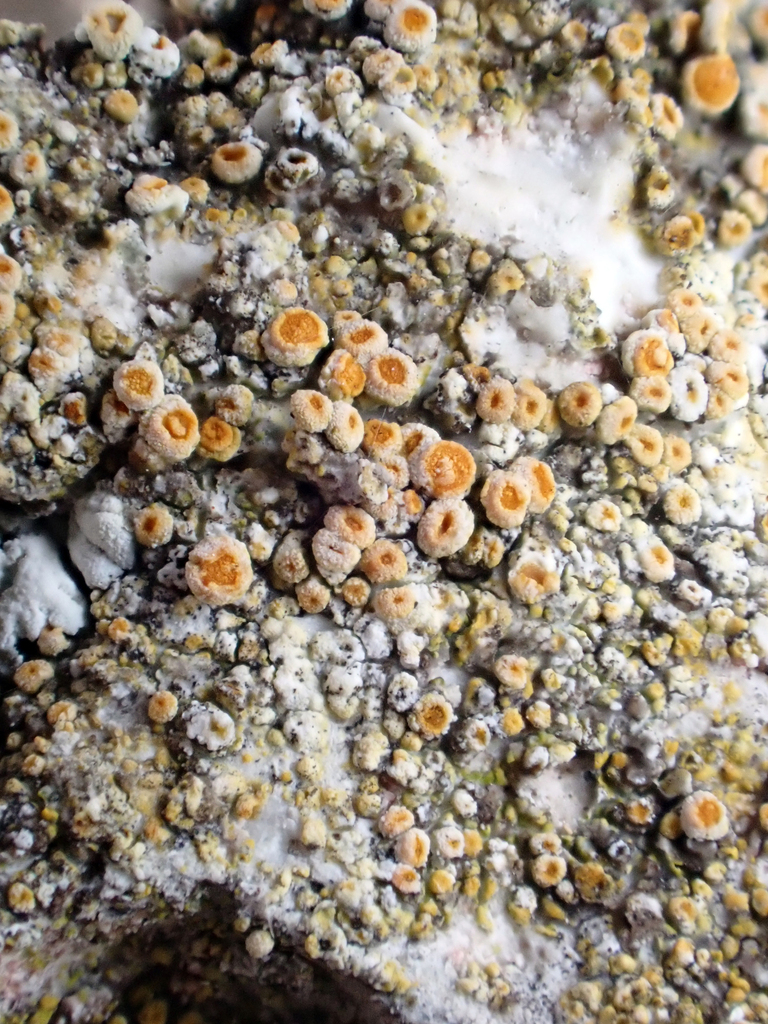
Limestone rock is slowly broken down by a special group of lichens, only found on this limestone. Caloplaca johnwhinrayi is common on small lagoon islands of Motuhinahina and Shag Rock, which is the only location in Aotearoa of this Australian species.
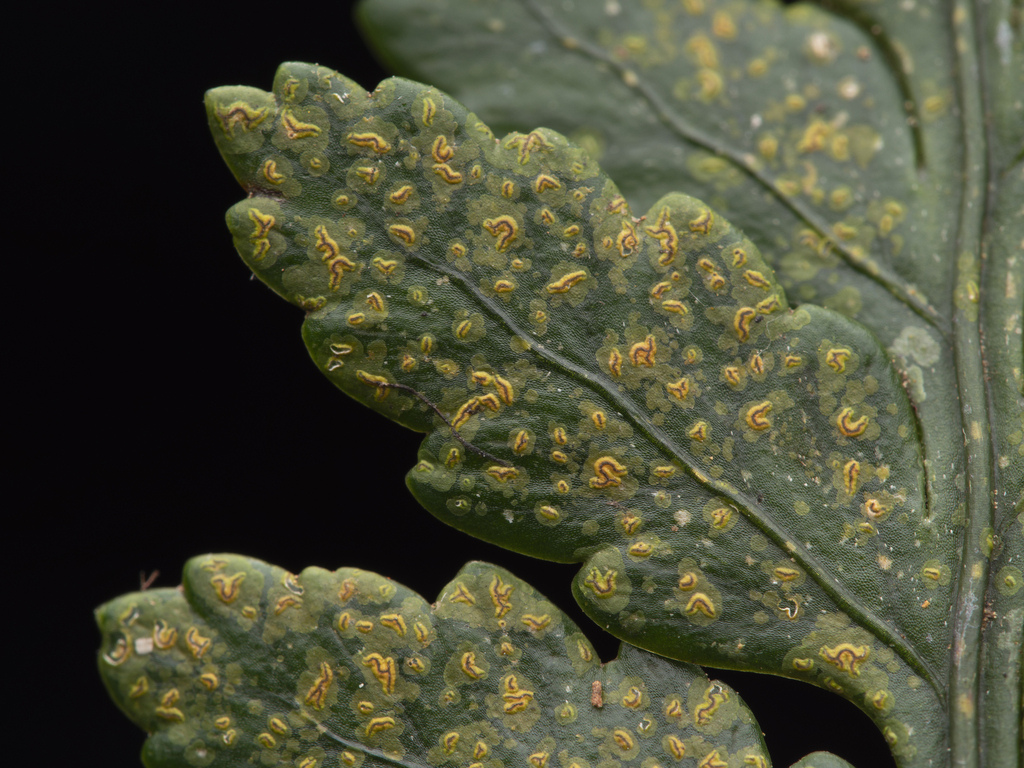
Further inland, the forests share equally colourful lichens. Enterographa bella (“bella” meaning beauty) grows on leaves of ferns and hoho. Large leaf-like foliose lichens, such as Pseudocyphellaria crocata, grow on trees in the damp forests of the Southern Tablelands, while Coenogonium goniocystosum grows on the filmy ferns beneath. Everywhere you look, lichens tend to be found.
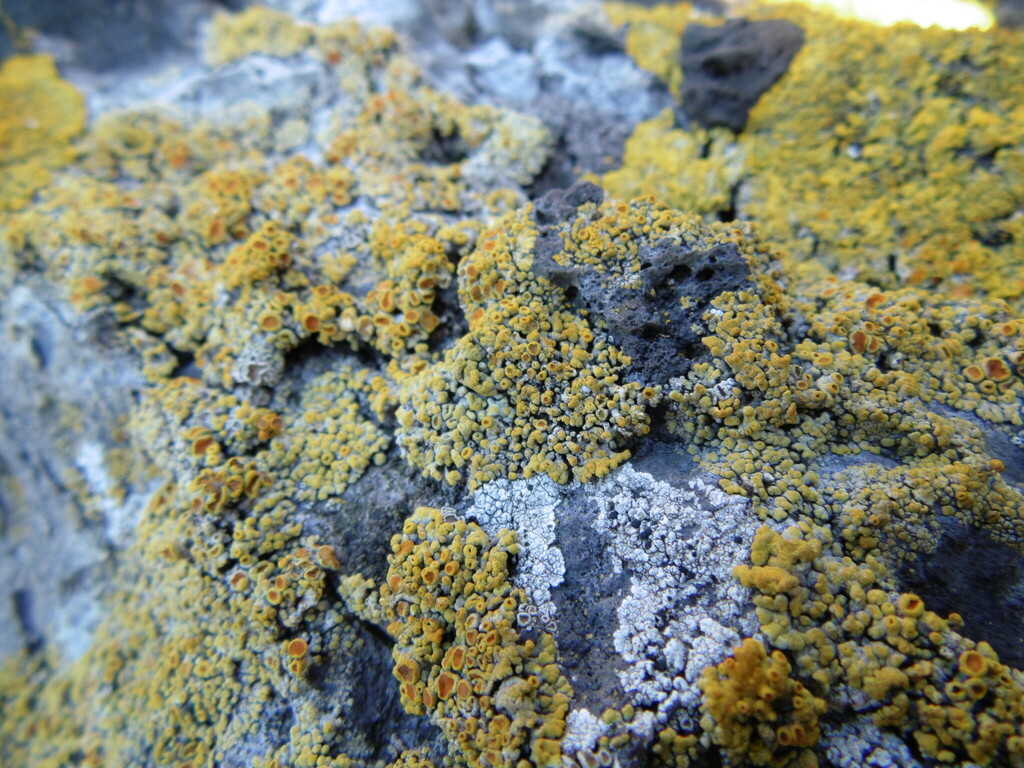
Rēkohu seems to be the stronghold for this coastal species Gondwania cribosa, found growing on basalt very close to the ocean. Image: Campbell James
We’re learning more all the time.
The world of lichens is microscopic and mostly unnoticed, although diverse, colourful, interesting and as important as any other part of our ecosystems. Those from Rēkohu are no different, and are found in every habitat, adding remarkable beauty for the appreciative eye.
Lichen-focused work continues on the island, with documentation of lichens common, rare, and completely new to science. We need to learn more about lichens to understand – and appreciate – their role in our land.
One topic of research is looking into whether the presence (or not) of lichens can be an indicator of the density of nesting birds.
Thank you to everyone who has supported research into lichens on the Chatham Islands, including landowners for allowing access.