Blog and news
Social Impact Assessment Report
The Predator Free Chathams Social Impact Assessment report is available to read.
A pulse check on our community's views
In 2025, we commissioned an independent Social Impact Assessment (SIA) to do a pulse check on how the Chatham Islands community feel about Predator Free Chathams (PFC). The report was finalised in early May 2026.
An SIA is a process that assists decision makers, affected people and communities to plan for and manage the impacts of a project. It’s one tool to help ensure broad involvement as a project is shaped and delivered.
This SIA was done by independent researchers Katherine Russell and Nick Taylor (both of whom already had some prior experience with the Chatham Islands and our community) and was funded by Predator Free 2050 Limited. Katherine and Nick spent two weeks in the Chathams meeting with people, building on desktop baseline work and online interviews. Although weather and transport meant they were unable to make it to Pitt Island, they did run online sessions specifically for Pitt residents. Everything in the report is anonymous.
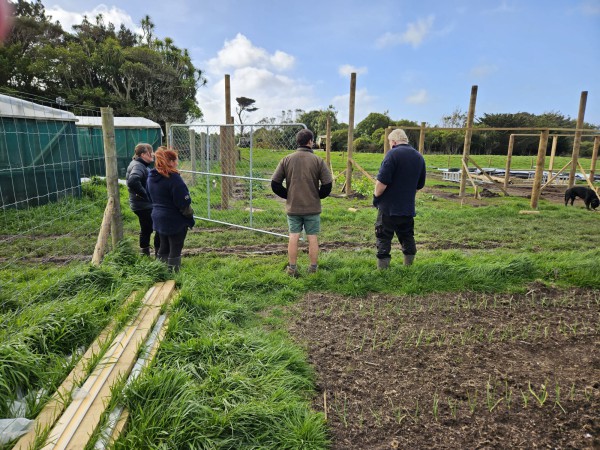
Discussing a new hot house during the Social Impact Assessment.
What's in the SIA?
Section B of the SIA provides an overview of the Chatham Islands in 2025, including population, economy, income, infrastructure challenges, and island governance.
It sets out examples of other eradication projects on inhabited islands, highlighting lessons that can be taken from them. It also emphasises the importance of ecological and social issues being considered together when planning predator eradication – and that island communities have their own unique challenges.
In Section C, the SIA finds that there’s general community support for the Landscape Restoration Trust, as well as the Trust being the lead of PFC. The biggest concerns people talked about related to the cost and feasibility of the project, along with methods that might be used in a predator eradication. There’s support for the northeast as the first stage for PFC, but the community knows there’s a lot of other conservation work happening across the islands and this should be reflected in the wider programme. The islands’ biosecurity is an area that will need strengthening – although the community already has good awareness about what biosecurity is and why it’s important.
The SIA identifies the opportunity for PFC to have significant economic and social benefits by supporting a stronger conservation economy on the islands. This includes the Trust employing locals in a flexible way that suits life on the islands. The SIA also highlights potential for economic diversification through the different types of worked associated with tourism (noting, too, that the growth of tourism should be managed carefully).
Top recommendations for the Trust
The key recommendations are that the Landscape Restoration Trust:
- continues to lead PFC work with technical support from key agencies
- finds long-term sustainable funding to secure work and enable an expansion of the project team
- prioritises the northeast phase and Pitt Island, and considers developing a comprehensive programme of conservation work in the Chathams
- develops community champions for PFC
- aims to become a dynamic and flexible employer, providing economic and social benefit to the community.
Our next steps
The report has useful feedback and constructive recommendations to consider. Some of them are going to take our Trust time to work through or put into action. That’s partly because we’re in the process of seeking longer-term funding and support that will allow us to do a lot more.
We're sharing this report with our community, our partners, and potential funders. It will help us demonstrate that the Chathams community is supportive of a predator free Chatham Islands and keen to be involved, and will also highlight the importance of this kaupapa to be community-led.
As our Trust scales up, our goal is to employ people in the Chatham Islands community. Funding has been our big constraint so far, but with the horizon looking promising we’re setting up the systems and processes to be able to do this.
Got questions?
If you have questions, email us at info@chathamrestorationtrust.org.nz.